

Manufacturer news from POLYDENTIA SA
QuickmatFIT, an anatomically shaped matrix for precise, natural contours
Published on
Achieving proper contact in Class II cavities is the most challenging clinically relevant aspect for clinicians.
A clinical study reports that 2.9% of failures in direct restorations are attributable to an unsatisfactory contact point or margin.1
Problems resulting from an insufficient contact area include tooth movement, lifting forces, food impaction, difficulty flossing, reduced effectiveness of brushing, and increased plaque buildup. This leads to periodontal damage characterized by pain, inflammation, and bleeding.2,3
Restoring the anatomy of the missing tooth is important not only to replace the missing structures, but also to restore ideal form and function.
Selecting a mold that is capable of mimicking or reproducing the tooth's original morphology and curvature is the first step toward a successful aesthetic and functional restoration.
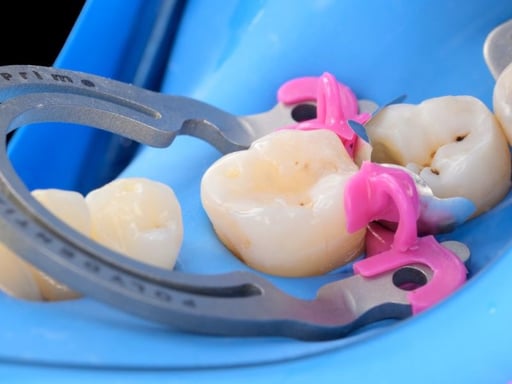
Sectional matrices are typically used in combination with a separator ring, which separates the teeth and stabilizes the matrix coronally, thereby promoting the formation of a contact surface.4,5
By engaging with the interproximal recesses and applying force to the remaining tooth structure, these systems effectively increase contact tightness compared to standard matrices or circumferential matrix systems.4,5
A restoration with the correct anatomical shape also reduces the need for rotary instruments required for contouring and finishing, thereby saving valuable time for both the dentist and the patient.
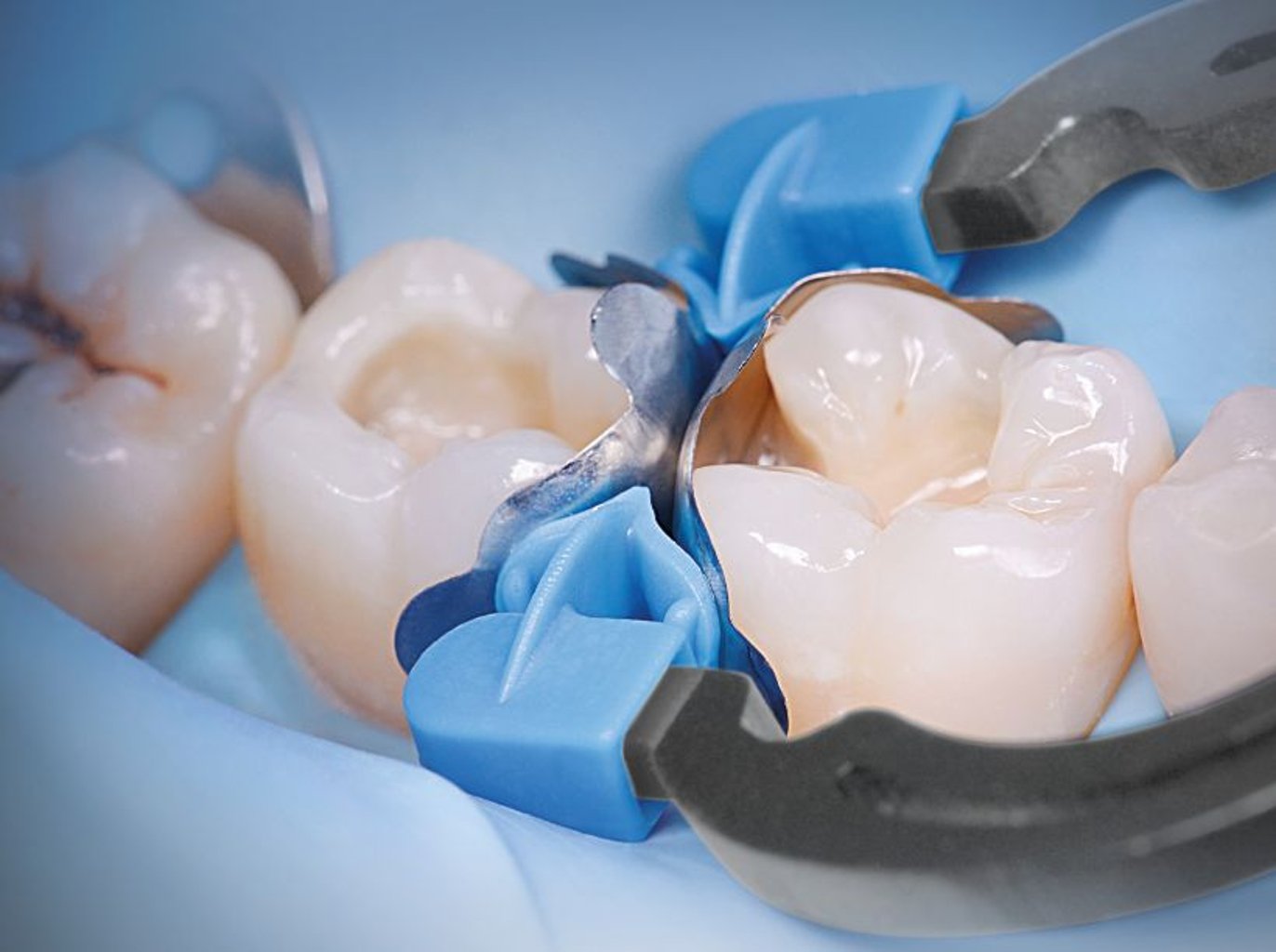
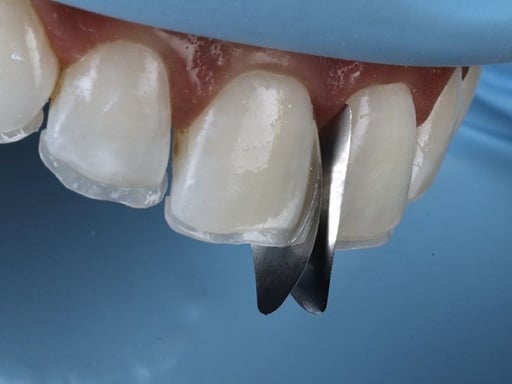
QuickmatFIT from Polydentia are the new anatomically optimized stainless steel matrices with a thickness of 0.04 mm, available in three anatomical shapes to accommodate all types of Class II posterior restorations. QuickmatFIT matrices are particularly indicated for wide interproximal spaces and large cavities.
Thanks to their positioning tabs, QuickmatFIT matrices are easy to handle and feature a rolled occlusal edge for easy restoration of the marginal ridge.
The pronounced curvature of the die conforms closely to the tooth, ensuring an improved fit and stability*, which makes it easier to achieve the correct restoration anatomy.
Advantages:
- Improved natural curvature: 3D-contoured matrices ensure anatomically accurate restorations
- Easy to use: The placement tabs (occlusal/buccal/lingual) make it easier and faster to insert and remove the matrices (the tip can be easily grasped with tweezers for proper positioning)
- Time-saving solution: anatomically accurate restorations reduce the time required for shaping and finishing
- three matrix molds (premolar, molar, and deep molar)
- thin, rigid, but flammable
- Molar-depth version for effective cervical margin seal
With the introduction of QuickmatFIT, clinicians can now select the Polydentia matrix that best meets their requirements in terms of height, thickness, concavity, and distance from the adjacent tooth.
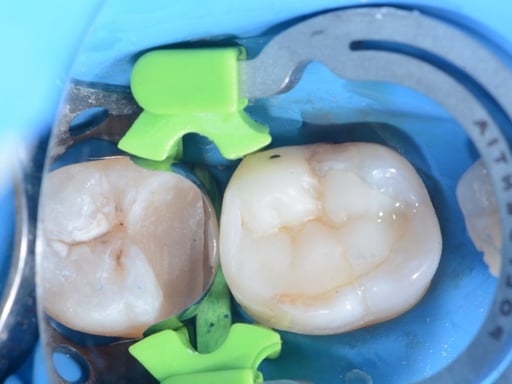
The use of an anatomically optimized QuickmatFIT partial matrix, in combination with a partial matrix ring (myQuickmat Forte Ring with myTines extensions) and interdental wedges (myWedge V-shaped plastic wedges) as part of a complete partial matrix system, ensures the successful restoration of Class II cavities with natural tooth anatomy.
Visit the corresponding product page to find out how your daily restoration routine can benefit from using the anatomically enhanced QuickmatFIT Sectional Matrices.
For demonstrations and/or sales inquiries, please contact your preferred international Polydentia sales partner.
Follow Polydentia on social media for the latest product updates, clinical cases, and other exclusive content.
PR QuickmatFIT Matrices (new tab)