

Manufacturer news from POLYDENTIA SA
Polydentia Launches myQuickmat Hoop: A Reliable Way to Measure Tooth Circumference
Published on
Circumferential matrix systems continue to play an important role in Class II restorations. Although sectional systems have become more widespread in recent years, circumferential matrices still account for about 30% of the global matrix market* and remain a proven choice, particularly in public health care and high-volume dental clinics.
Development Opportunities for Traditional Circumferential Die Systems
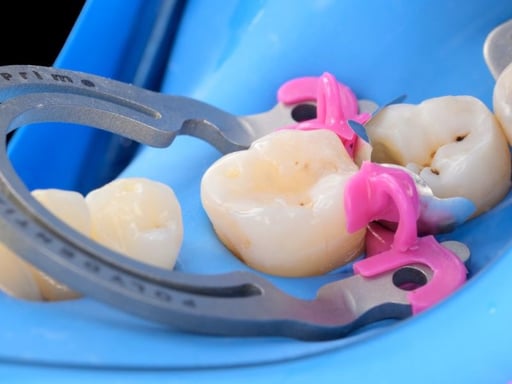
Conventional circumferential matrix techniques, such as the Tofflemire system, have long been valued for their simplicity, familiarity, and versatility. However, when used for Class II restorations, dentists may have difficulty consistently replicating the ideal tooth anatomy and achieving predictable proximal contacts. In some cases, the restorations may appear flatter, and it can be difficult to optimize contact density.
These defects can lead to food retention, black triangles, plaque buildup, patient discomfort, and an increased risk of restoration failure.
In addition, isolation and marginal control may require special attention, particularly in complex cases or when adjacent teeth are malpositioned. The size and rigidity of conventional matrix holders can also limit access for placing wedges, thereby impairing overall handling efficiency.¹
Why introduce a new circumferential matrix system?
Because we recognized an opportunity to enhance the benefits that dentists already value in circumferential systems, while also addressing the challenges they are familiar with.
We examined solutions from every angle—360° around the globe 😉—to find a circumferential matrix system that combines reliability with exceptional ease of use and intuitive operation.
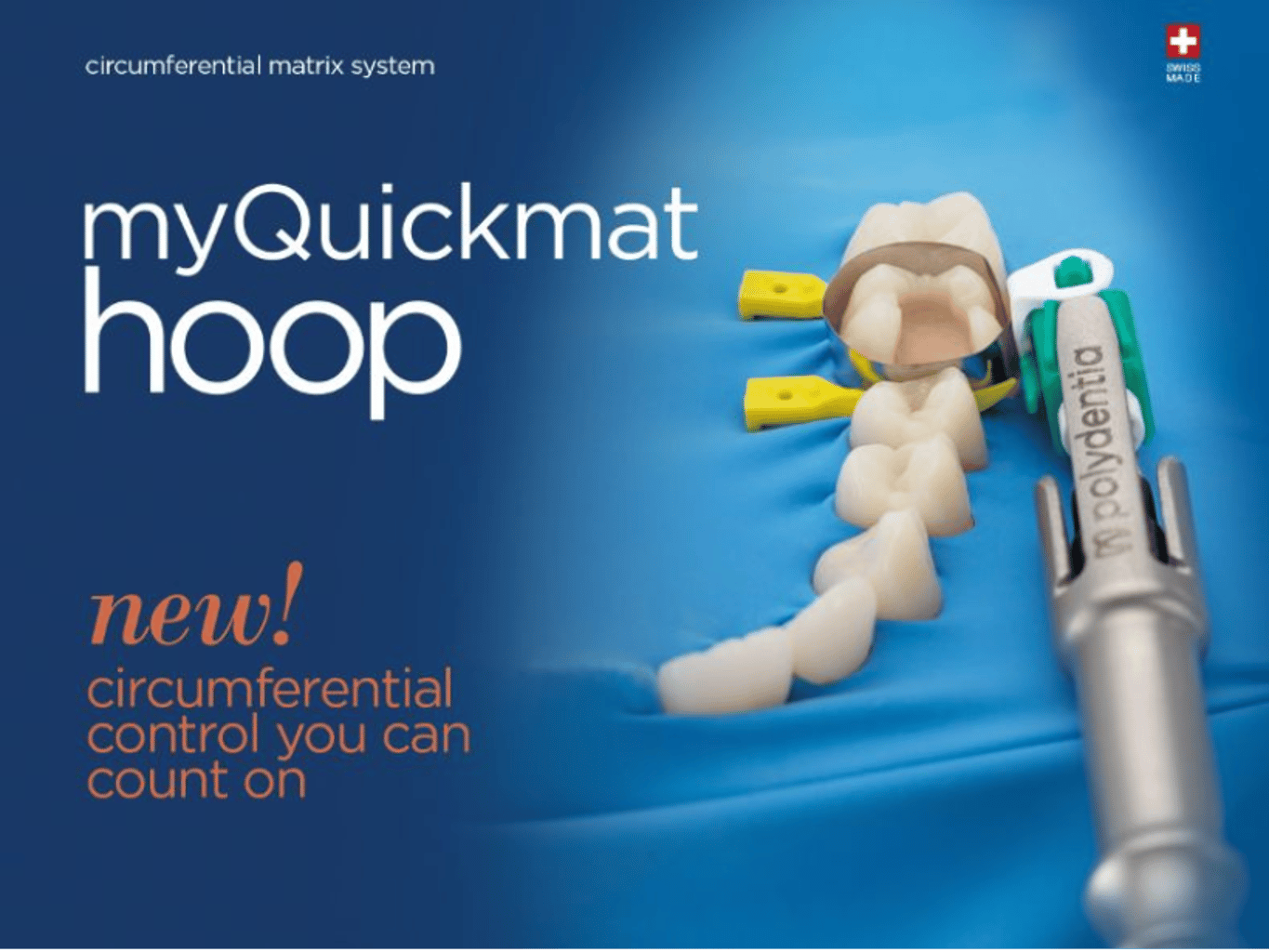
The result is myQuickmat Hoop: a system that maintains the familiar workflow for placing a Tofflemire retainer while eliminating many of the traditional limitations. With easy placement, anatomical contours, a compact design, rigid film, and full swiveling capability, myQuickmat Hoop sets new standards for modern circumferential matrix band systems.
The system includes a selection of standard and tabbed, pre-tensioned circumferential matrices, an instrument, and plastic interdental wedges used to stabilize the matrices and separate adjacent teeth.
Pre-stressed circular dies “Quickmat Hoop”
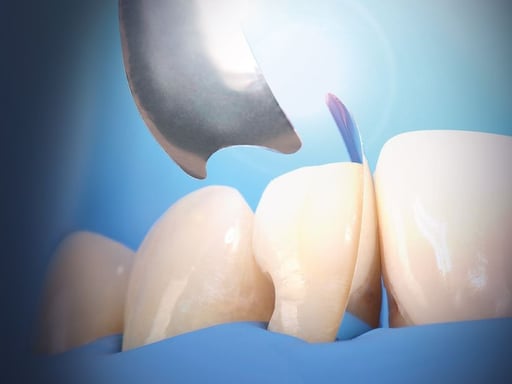
The Quickmat Hoop is a pre-tensioned, contoured circular matrix designed to ensure precision and consistent clinical results. The removable stainless steel instrument (myHooper instrument) allows for quick, intuitive placement using the Tofflemire technique without leaving a bulky holder in the patient’s mouth. This prevents damage to soft tissue and stops the matrix from slipping during the procedure.
The color-coded, adjustable retainer fits securely and does not come loose, while the swiveling arm allows it to be used in any quadrant.
Advantages:
- Easy to insert, similar to a Tofflemire retainer, but without its drawbacks
- Removable tool for quick insertion, tightening, and adjustment
- Anatomically shaped strip for tight margins and natural-looking restorations
- Compact design, ideal for tight spaces, including the second and third molars
- 35-micron rigid, contoured film: sturdy, dimensionally stable, and fits easily through tight contacts
- Color-coded, adjustable plastic mount that stays securely in place without coming loose
- Swivel-mount arm for use in any quadrant
Sizes and Models
The pre-stressed Quickmat Hoop circumferential dies are available in two circumferential sizes and three height options (5.5, 6.5, 8.0 mm):
- The large size is primarily designed for molars.
- Its small size makes it suitable for both premolars and smaller molars.
The shape at the base of the band first tapers and then widens again. It mimics the shape of a normal tooth, which, as we know, does not stand upright.
Control Hoop Tabs for Challenging Cases
In complex clinical situations or when adjacent teeth are malpositioned, it can still be difficult to achieve optimal fit and firm contacts. To address this, the band is also available with Control-Hoop tabs, which were specifically designed to enable reliable, tight contacts in large, multi-surface composite restorations.
Open contacts often occur when the matrix band accidentally detaches from adjacent teeth. During light-curing, the tabs can be gently pulled with an explorer to maintain firm contact and ensure tight interproximal contacts. Alternatively, they can be temporarily attached to the occlusal surfaces of adjacent teeth using a bonding agent and flowable composite, which allows for the simultaneous filling and curing of both the mesial and distal boxes, thereby saving valuable clinical time.
A Complete Matrix Solution
The myQuickmat Hoop Set includes a selection of 40 regular and tabbed matrices, 2 instruments, and a pack of 100 assorted myHoopy plastic wedges, which are used to stabilize the matrices and isolate the adjacent tooth.
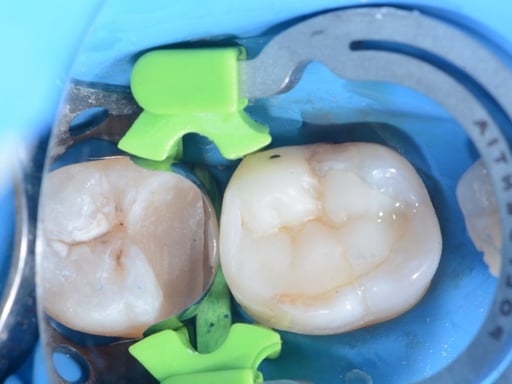
The myHoopy wedge ensures reliable separation, effective tissue compression, and a secure matrix seal to prevent fluid leakage. Its parallel walls and gradually increasing stiffness allow for smooth insertion and firm stabilization once it is in place. A ski-jump-style tip protects the papillae, while the ergonomic handle—with integrated stops and an insertion opening—enables controlled, precise handling.
Visit the corresponding product page to learn how your daily restoration routine can benefit from using the myQuickmat Hoop circumferential matrix system.
For demonstrations and/or sales inquiries, please contact your preferred Polydentia international sales partner.
Please note that product availability is currently limited to the EU, Switzerland, and the United Kingdom.
Follow us on social media to get the latest product updates, clinical case studies, and other exclusive content
myQuickmat Hoop website page (new tab)